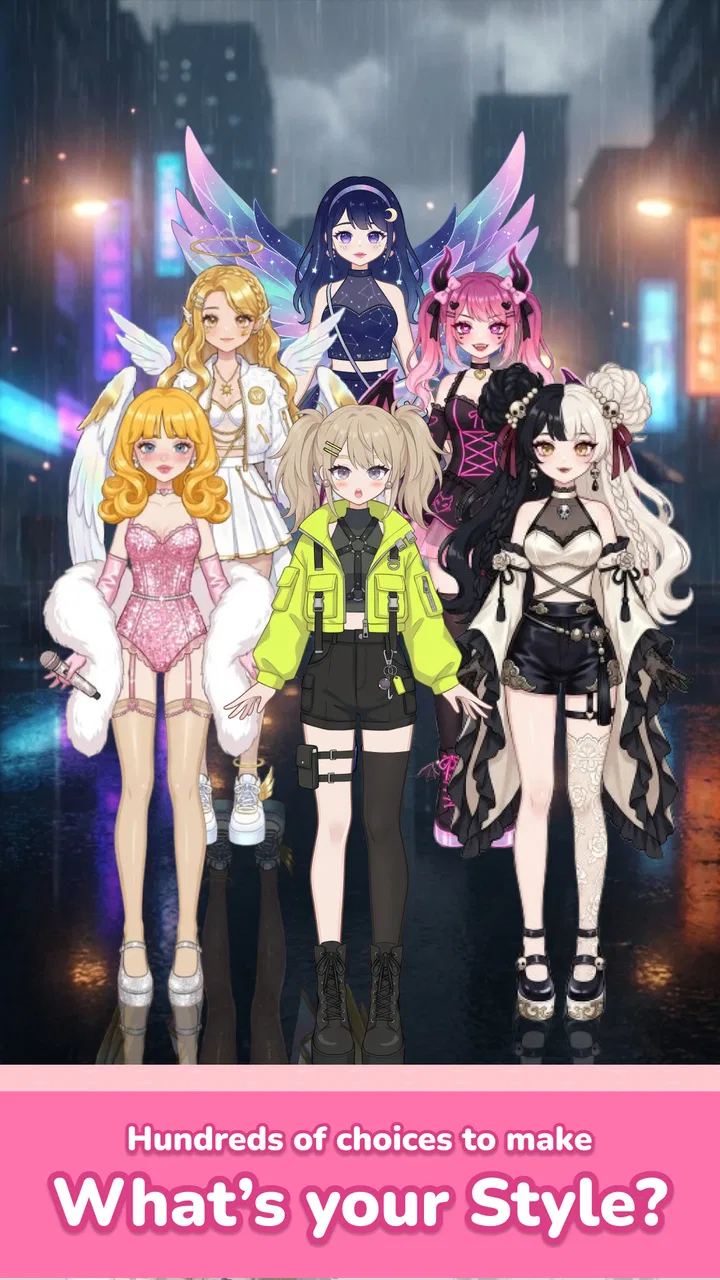
Fashion Style: Anime Dress Up
- 4.4
- Rating
- 500.00K
- Installs
- Free
- Price

 Analysis by App-foxy
I spent time with Fashion Style: Anime Dress Up as a light role-playing game built around clothing choices, character makeovers, and personal style. Its appeal is easy to understand: you choose an anime-inspired girl, assemble an outfit, adjust the overall look, and decide whether your final design feels polished, dramatic, cute, or deliberately unusual. It is free to play, aimed at Everyone, and comes from Apero Game Publishing.
That simple premise makes it approachable, but it also means the game is best judged as a creative dress-up experience rather than as a deep role-playing adventure. I would recommend it to someone who enjoys experimenting with outfits in short sessions, especially when they want something calmer than a combat-focused game. I would not choose it for a player looking for exploration, a large story campaign, or complicated character progression.
How Fashion Style: Anime Dress Up Turns Outfit Choices Into the Main Game
I focus here on why outfit-building carries the experience, and how a simple design brief can make each makeover feel more intentional than tapping through choices at random. I also consider the trade-off between creative freedom and the external goals some players expect from a role-playing game, which leads into a closer look at practical styling decisions.
You May Also Like

 Blood Strike: 2.5 Anniversary
Blood Strike’s Loadouts Turn Every Drop Into a Tactical Gamble
A close look at Blood Strike’s custom loadouts: how fast access to signature weapons reshapes its battle royale rhythm, rewards preparation, and narrows the gap between fights.

 Pandora - Music & Podcasts
Pandora’s Music Is Easy to Start, but Harder to Recover
Pandora’s strength is its low-effort path from a seed to a station. Its weak spot is how much confidence it asks you to place in connection, setup, and quiet recovery.

 8 Ball Pool
 Is Built on Rivalries, Rematches, and Routine
A close look at the rivalries, rematches, shared routines, and unanswered safety questions that turn a quick pool match into a persistent mobile community.

 Samsung Music
’s Quiet Strength Is Playing What You Already Own
Its reach comes less from spectacle than from dependable access to a personal library. That simplicity is both the app’s strongest retention engine and its ceiling.

 AccuWeather: Weather Radar
AccuWeather Review: A Quick, Clear Forecast for Everyday Decisions
For everyday plans, the best forecast is the one you can understand quickly. AccuWeather makes rain timing, radar, and local conditions easy to act on, with a few trade-offs.

 Hill Climb Racing
Why Hill Climb Racing Still Turns Crashes Into One More Run
A tiny car, a bumpy hill and one more upgrade: Hill Climb Racing keeps resurfacing because its simple chaos makes every near-miss feel personal.
More From Our News Desk
View All News


The real decision space is in the styling process
The interesting part of this game is not simply tapping the most attractive item. It is deciding what kind of character you want to create before you start adding pieces. A soft color palette can make a look feel gentle and everyday, while sharper contrasts can push it toward a more confident or theatrical anime style. That gives each session a small creative objective, even when the game itself is not asking you to solve a traditional role-playing quest.
I found it more enjoyable when I treated each makeover as a theme rather than as a search for one perfect item. For example, I might begin with a hairstyle that suggests a quiet school character, then choose clothes that support that impression instead of mixing every eye-catching option together. This approach makes the wardrobe feel more manageable and helps avoid a common problem in dress-up games: adding attractive pieces that do not work well as a complete outfit.
The game’s short description, “Fashion Style,” is accurate but understated. The experience is specifically about combining fashion elements and shaping a finished anime-style presentation. That makes the order of decisions useful. I prefer choosing the overall mood first, then the main clothing, followed by supporting details. Starting with small accessories can be distracting because they may look appealing on their own but leave the rest of the design without a clear direction.
Small styling rules make a bigger difference than collecting everything
One practical lesson is to think in terms of visual balance. If the clothing already has a strong pattern or a bold silhouette, a simpler hairstyle or accessory can keep the character readable. If the outfit is plain, a more distinctive hair choice or finishing detail can give it personality. This is not a complicated system, but it creates a meaningful trade-off between variety and coherence.
I also recommend taking a moment to compare the complete look rather than judging each selection immediately. An item that seems weak by itself can become useful once the color and shape of the rest of the outfit are established. Conversely, a spectacular piece can dominate the design and make every later choice feel forced. Players who enjoy planning will get more from the game than those who simply tap through options as quickly as possible.
The strongest results usually come from choosing a mood first and shopping for details second. That habit turns the game from a sequence of cosmetic taps into a small design exercise. It also gives repeat sessions a sense of purpose, because I can return with a different brief: casual, elegant, playful, bold, or intentionally mismatched.
Where the role-playing label fits
As a role-playing title, the game uses the idea of creating and presenting a character more than it uses traditional role-playing systems. The focus is on identity through appearance. There is no need to learn a combat build or manage a party before enjoying the central activity. That makes it friendly to players who like character customization but do not usually play role-playing games.
This also explains the main limitation. Anyone expecting dialogue-heavy storytelling, tactical battles, exploration, or a long progression arc may find the experience too narrow. The role-playing category sets an expectation of character involvement, but here that involvement is primarily visual and creative. I see that as a clear design choice rather than a flaw, provided the player knows what kind of game this is.
Risk and reward in a low-pressure fashion game
The risks here are mostly creative rather than strategic. Choosing a dramatic item may improve the outfit, or it may make the character feel visually crowded. Trying an unusual combination can produce a memorable result, but it can also make the design less consistent. Because the game is built around experimentation, those failures are part of the value rather than a reason to stop playing.
There is also a practical resource question whenever a free dress-up game includes optional purchases. Fashion Style is free to play, with in-app items priced from around two dollars to around ten dollars each. That range makes it important to decide early whether you are enjoying the act of styling or simply feeling pressure to acquire every attractive option. My advice is to treat paid pieces as optional additions, not as requirements for having a worthwhile session.
That distinction matters because dress-up games can encourage completionist habits. A player may begin by making one character and then feel tempted to chase a more complete wardrobe. If you prefer a controlled experience, set a personal limit before browsing optional content. The game works best when purchases support a specific creative idea, such as completing a planned theme, rather than when they become the goal of the session.
For younger players, the Everyone content rating makes the game broadly accessible, but adults may still want to supervise spending on a shared device. The age rating describes the intended content audience; it does not remove the need for sensible purchase boundaries. I would especially recommend turning a play session into a design challenge before considering any optional item, because that keeps the focus on creativity.
A realistic everyday use case
I can see this fitting naturally into a short break after work or school. If I have only a few minutes, I can open the game, choose a character, and try to build one complete look around a simple idea. I might decide that the character needs a relaxed weekend style, then make choices that support that theme instead of trying to explore everything at once. The session has a clear beginning and end, which makes it easier to enjoy casually.
It can also work as a shared activity. One person can suggest a theme while another makes the choices, or two players can independently design characters around the same prompt and compare the results. That kind of use highlights the game’s creative side without pretending it is a competitive strategy title. The fun comes from interpretation: two people can receive the same general idea and produce very different anime-inspired looks.
What to do when the first outfit does not work
My most useful adjustment was to avoid rebuilding everything immediately. When a look felt wrong, I changed one visual layer at a time. First I reconsidered the main clothing, then the hair, and only afterward the smaller details. This made it easier to identify the source of the problem. If I changed everything at once, I could not tell which decision had improved or weakened the design.
Another helpful habit is to keep a mental distinction between “interesting” and “finished.” An unusual item may be worth keeping because it adds character, even if the outfit needs quieter supporting choices. A finished look does not have to use the most decorative options available. In fact, restraint often makes the central idea clearer, particularly when the character already has a strong hairstyle or a distinctive outfit shape.
Adapting your approach instead of repeating one formula
Players who always choose the same color family may enjoy the first sessions but eventually feel that every character looks similar. I found more value in changing the design rule from one attempt to the next. One session can focus on matching colors, another on contrast, and another on building a character around one standout piece. These self-imposed limits create variety without requiring a complex game system.
Adaptation is also useful when an outfit looks good in theory but not as a whole. Rather than forcing the original plan, I would keep the strongest element and change the theme around it. A formal-looking piece might become the foundation for an elegant character, while a playful item could redirect the design toward something more energetic. This flexible approach is more productive than trying to make every selection fit an idea that has stopped working.
The game is especially suitable for players who like visual iteration. You can make a first attempt, notice what feels unbalanced, and refine the result with a clearer goal. That is different from a game where a wrong decision causes permanent damage. Here, the consequence is simply an outfit you may not like, so experimentation remains comfortable. The trade-off is that players who need external goals may find this freedom less motivating.
How it compares with typical alternatives
Compared with fashion games that emphasize timed challenges or score chasing, Fashion Style feels more relaxed and personal. I would choose it when I want to make a character without the stress of meeting a countdown or satisfying a judging system. The benefit is creative control. The cost is that there may be less urgency, competition, or pressure to improve from one round to the next.
Compared with story-driven role-playing games, it is much easier to pick up but far less substantial in narrative and progression. A traditional role-playing game is the better choice if you want quests, combat decisions, world-building, or a character whose abilities develop over a long campaign. This game is better when the character’s appearance is the main reason you are playing.
It also differs from purely decorative avatar creators because the role-playing framing gives the makeover a little more identity. You are not only arranging isolated clothing pieces; you are trying to communicate who the anime-style character might be. That said, players who want social interaction, detailed photo tools, or a large community layer should look toward a different type of app. Fashion Style is strongest as a focused solo styling activity.
Depth over time depends on your own challenges
The game has enough room for repeated experimentation, but its long-term appeal will depend heavily on what you bring to it. If you enjoy making themed characters, comparing different silhouettes, and refining color choices, the simple structure can remain pleasant. If you need constant unlocks, story developments, or new gameplay systems, the experience may lose momentum sooner.
I would approach it in phases. During the first sessions, learn how the available clothing and makeover choices work together. After that, stop trying to use everything and begin designing with a specific concept. Later, revisit earlier ideas and see whether a quieter combination works better. This creates a personal progression in skill, even when the game itself is not being treated like a traditional character-building campaign.
Its current version is 1.2.8, and the game requires Android 8.0 or later. Those details matter if you are installing it on an older device, but they do not change the central recommendation: check that your phone meets the minimum system requirement, then judge the game by whether you enjoy visual customization. The experience is not intended to replace a full role-playing adventure.
The audience size suggests that the concept has found interest, with over half a million installs and a 4.4 average from around one and a half thousand ratings. I would read those figures as a sign that the accessible dress-up format is working for many players, while still remembering that a popular casual design is not automatically the right match for someone seeking deep mechanics.
Who should play, and who should skip it
I think the game is a good fit for anime fashion fans, casual players, younger users who enjoy appearance-based creativity, and anyone who wants a short activity without combat or complicated rules. It is also a reasonable choice for people who like making characters for personal amusement rather than competing for a leaderboard position.
I would skip it if your main reason for downloading a role-playing game is story, tactical decision-making, exploration, or meaningful character statistics. I would also be cautious if you dislike optional purchases in free games or tend to feel that a wardrobe is incomplete unless you own every appealing item. The free entry point is useful, but the purchase range means self-control remains part of the experience.
My strategy verdict after playing
My recommendation is to play Fashion Style as a compact creative workshop. Begin with a theme, choose one anchor item, and let the rest of the outfit support it. When a look feels crowded, remove or simplify one element instead of adding another. When it feels plain, introduce one deliberate contrast rather than decorating every available space. These small decisions produce more satisfying results than simply selecting the most elaborate options.
Apero Game Publishing has kept the central idea easy to understand: dress up anime-style girls, experiment with makeovers, and build a personal fashion result. The game’s strength is its accessibility and the freedom to try combinations without the burden of a complex role-playing system. Its weakness is the same simplicity; players wanting a richer campaign may quickly reach the limits of the format.
After weighing that trade-off, I would recommend it as a free, low-pressure dress-up game rather than as a full-scale role-playing experience. Fashion Style: Anime Dress Up is most enjoyable when you set your own creative objective and accept that not every outfit will work on the first try. If that kind of visual experimentation sounds relaxing, it is worth trying. If you need a story, competition, or deep progression to keep you engaged, a more traditional role-playing alternative will serve you better.
FAQs for Fashion Style: Anime Dress Up
01What is Fashion Style: Anime Dress Up?
Fashion Style: Anime Dress Up is a creative and engaging mobile app that allows users to design and customize anime characters' outfits. By selecting from a wide range of clothing, hairstyles, and accessories, users can enjoy endless possibilities in fashion design, making it popular among anime enthusiasts and fashion lovers.
02Is Fashion Style: Anime Dress Up free to play?
Yes, the app is free to download and play. However, it offers in-app purchases for additional features, clothing packs, and accessories. These optional purchases enhance the gaming experience by providing more customization options, but they are not necessary to enjoy the core gameplay of designing outfits.
03What age group is Fashion Style: Anime Dress Up suitable for?
The app is designed for users of all ages who have an interest in anime and fashion. It is particularly popular among teenagers and young adults. The user-friendly interface and straightforward gameplay make it accessible and enjoyable for younger audiences as well, although parents might want to supervise in-app purchases.
04Does Fashion Style: Anime Dress Up require an internet connection?
While the app can be played offline, certain features such as downloading new clothing packs or accessing community designs require an internet connection. To fully enjoy all the features and updates, it's recommended to have a stable internet connection when using the app.
05Can I share my designs from Fashion Style: Anime Dress Up?
Yes, the app allows users to share their creations with friends and the broader community. You can save your designs to your device or share them directly on social media platforms. This feature encourages creativity and interaction, allowing users to showcase their unique fashion styles.
Pros
- Extensive wardrobe options for customization.
- User-friendly interface enhances creativity.
- Regular updates with new outfits and styles.
- High-quality graphics for an immersive experience.
- No internet required for gameplay.
Cons
- Limited free items; in-app purchases needed.
- Some outfits can be repetitive over time.
- Occasional ads interrupt gameplay.
- Lacks multiplayer or social sharing features.
- Slow loading times on older devices.

Fashion Style: Anime Dress Up
Gallery